
School of Artivism
School of Artivism
Seeds of change, acts of care, for a culture of climate courage
What if art were our magnetic compass to navigate the Anthropocene?
Our best weapon of mass construction to build a shared future based on justice, dignity, sustainability, inclusion, and care for all living beings?
Humanity’s most advanced technology for cultivating peace, resilience, and collective transformation?
The School of Artivism is a free, experimental learning programme for young artists (35 and under) exploring how art can generate real-world impact through ecological and social engagement. Curated by Julia Rajacic and Tiziana Pers, and supported by BJCEM, the programme brings together guest artists, thinkers, and activist practitioners to share tools, stories, and strategies for systemic transformation.
Running from September to October 2025, the school offers 8 online sessions, including two public events. Each session invites participants to dive into practices that are embodied, collaborative, and politically imaginative.
This is not a school of theory, but a space for repairing, reimagining, and co-creating — a temporary yet lasting community of artists ready to act with courage, care, and creativity.
New deadline for applications: July 28, 2025
The co-curators and tutors
-
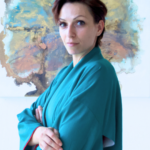
- Julia Rajacic
-
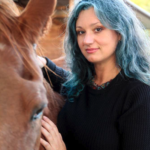
- Tiziana Pers
Julia Rajacic is an independent curator, art consultant, and ICOM member. Since 2015, her curatorial research has focused on ecology. Following the Gaïa exhibition (COP21, Mairie de Paris), and driven by a personal commitment to coherence, she made eco-design central to her projects. In 2019, she founded Jardino, a creative agency promoting ecological transition through art. Since 2023, she has been an active member of the Gallery Climate Coalition (GCC).
Tiziana Pers is a visual artist and activist whose work explores the relationship between human and nonhuman animals, with a focus on biocentrism and antispeciesism. Her practice challenges systems of domination through symbolic, poetic, and political gestures, often developed in collaboration with zoologists, philosophers, and scientists. She is the co-founder and artistic director of RAVE East Village Artist Residency, a project dedicated to rethinking the role of contemporary art in relation to animal otherness.
The tutors
-
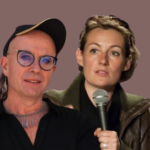
- Jay Jordan and Isa Fremeaux
-

- Christophe Meierhans
-
- MICAA
-
- Igor Grubić
-
- Cassie Thornton
-
- Paolo Naldini
The Laboratory of Insurrectionary Imagination (Jay Jordan and Isa Fremeaux) – Infamous for fermenting mass disobedience on bicycles during Copenhagen’s UN climate Summit, touring the UK recruiting a rebel clown army, building an illegal lighthouse on the site of an airport control tower, launching a rebel raft regatta to shut down a coal fired power station and refusing to be censored by London’s Tate Modern museum, the Laboratory of Insurrectionary Imagination has been walking on the tightrope between art and activism since 2004.
Christophe Meierhans works in performing arts, music and pedagogy. Infused by degrowth values and perspectives, his practice is rooted in ecology and systems thinking. Meierhans is a founding member of the C&H performance collective, The Common Wallet, Extinction Rebellion Belgium, and the More than Enough campaign. His participative theater performances were shown in numerous festivals and theaters internationally and he was artist in residence at the Kaaitheater in Brussels as well as associated artist with the Nouveau Theatre de Montreuil in Paris. From 2025 until 2027 he is co-curator of the School of Enough an international exchange program for activist-artistic projects in Italy, Poland, Hungary and Switzerland.
The MICAA Mediterranean Institute for Contemporary Artistic Activism fosters a stable and tangible connection between the humanitarian work of internationally active non-governmental organizations (NGOs) and the world of contemporary art. Believing in the power of contemporary art as a universal language and a mirror of our times, the institute offers NGOs the opportunity to collaborate with emerging young artists, promoting mutual enrichment and shared impact.
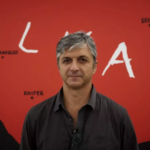
Igor Grubić is a multimedia artist known for site-specific interventions in public spaces, as well as photography and film. He represented Croatia at the 58th Venice Biennale. His critically engaged, socio-politically committed practice is marked by sustained engagement and focuses on both past and present political realities. His work explores a wide range of themes, from the fate of historical monuments and the decline of industry to the experiences of minority communities. While rooted in the documentary tradition, Grubić’s photography and film are distinguished by an affective, empathetic approach that is deeply humane and often poetic.
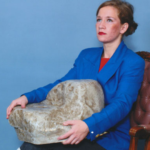
Cassie Thornton is an artist and activist who makes a “safe space” for the unknown, for disobedience, and for unanticipated collectivity. She uses social practices including institutional critique, insurgent architecture, and “healing modalities” like hypnosis and yoga to find soft spots in the hard surfaces of capitalist life. Cassie has invented a grassroots alternative credit reporting service for the survivors of gentrification, has hypnotized hedge fund managers, has finger-painted with the grime found inside banks, has donated cursed paintings to profiteering bankers, and has taught feminist economics to yogis (and vice versa).
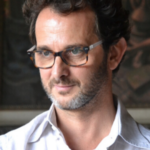
Paolo Naldini is the Director of Cittadellarte, founded on Michelangelo Pistoletto’s Manifesto Progetto Arte. The foundation promotes art as an enzyme of transformation, activating change through the dual lens of freedom and responsibility. Based in Biella (Italy), Cittadellarte has evolved into a school-laboratory that integrates artistic practice with all sectors of society to turn the symbol of the Third Paradise into lived reality. Naldini’s research focuses in particular on Demopraxy — a participatory method for societal transformation grounded in active citizenship and creative co-responsibility.
School of Artivism Program
Seeds of change, acts of care, for a culture of climate courage
📌 Sept 9 – Taste of change: Creative approaches to sustainable food systems that honor the living world – Tiziana Pers (PUBLIC – Zoom LINK)
📌 Sept 16 – Disobedient art for systemic change – The Laboratory of Insurrectionary Imagination (School)
📌 Sept 23 – Creative coherence: Aligning aesthetics, ethics and impact – Julia Rajacic (PUBLIC – Zoom LINK)
📌 Sept 30 – Practising enoughness: Art in a post-growth paradigm – Christophe Meierhans (School)
📌 Oct 7 – Artistic activism in humanitarian contexts – The MICAA (School)
📌 Oct 14 – Collective governance: Co-creation and decision-making resources to activate collective demopraxy – Paolo Naldini (School)
📌 Oct 21 – The art of bearing witness: Narratives of the marginal and the invisible – Igor Grubić (School)
📌 Oct 28 – Safe space for the unknown: Disobedience & collective care – Cassie Thornton (School)
All sessions run from 6:30–8:30 PM CEST.
Selected Artists
Holly Adams (UK)
Pietro Calligaris (Italy)
Johannes Equizi (Italy/Germany/The Netherlands)
Di Fang (The Netherlands)
Nafsika Hadjichristou (Cyprus)
Emma Lewis-Jones (Scotland)
Lena Longefay (France)
Giulia Mattera (Italy/Sweden)
Hagar Masoud (Egypt/USA)
Melagrama – Eleonora Furini & Miriam Muscas (Italy/Poland)
Dilan Perisan (Italy/Turkey)
Savina Ražnatović (Montenegro)
Eleonora Roaro (Italy)
Cesare Rosa (Italy)
Tommaso Sandri (Italy)
Rebecca Sforzani (Italy)
Constantin Schlachter (France)
Agata Szymanek (Poland)
Ucci Ucci – Salvatore Cucitti & Gloria Zeppilli (Italy)
Elena Zecchin (Italy)
Self-organized School of Artivism: Discussing Communities
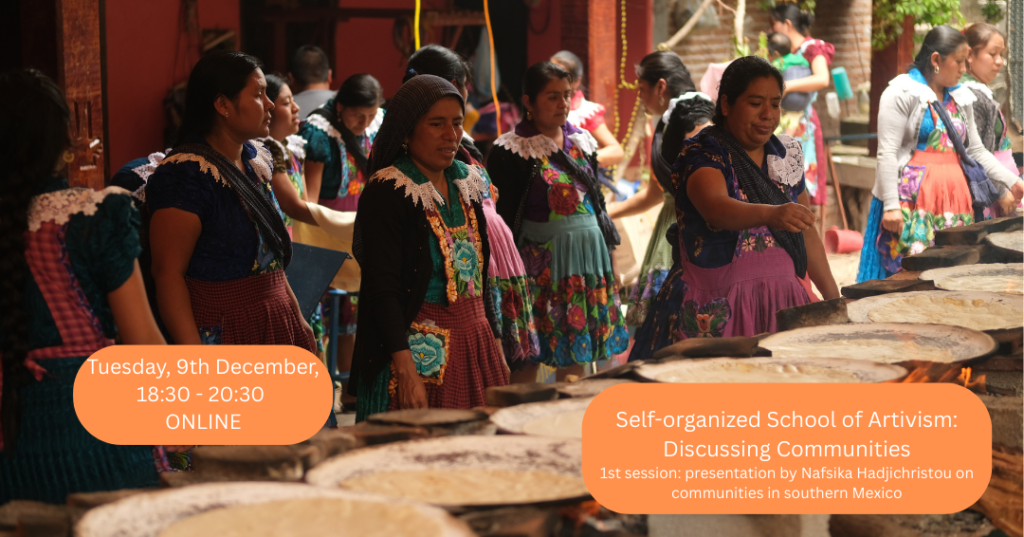
For all participants interested in staying connected to the informal, self-organized community, the first independent session will take place:
Tuesday, 9 December
18:30–20:30 CET
Join via Jitsi: https://meet.jit.si/Artist%E2%80%99smeeting
Theme: Discussing Communities
The meeting will begin with a round of introductions and a discussion on what “community” means for each participant.
The second part will feature a presentation by Nafsika Hadjichristou on communities in the south of Mexico, followed by an open conversation on the topic.
Participants who wish to receive reminders and updates are encouraged to add their contact information HERE.